
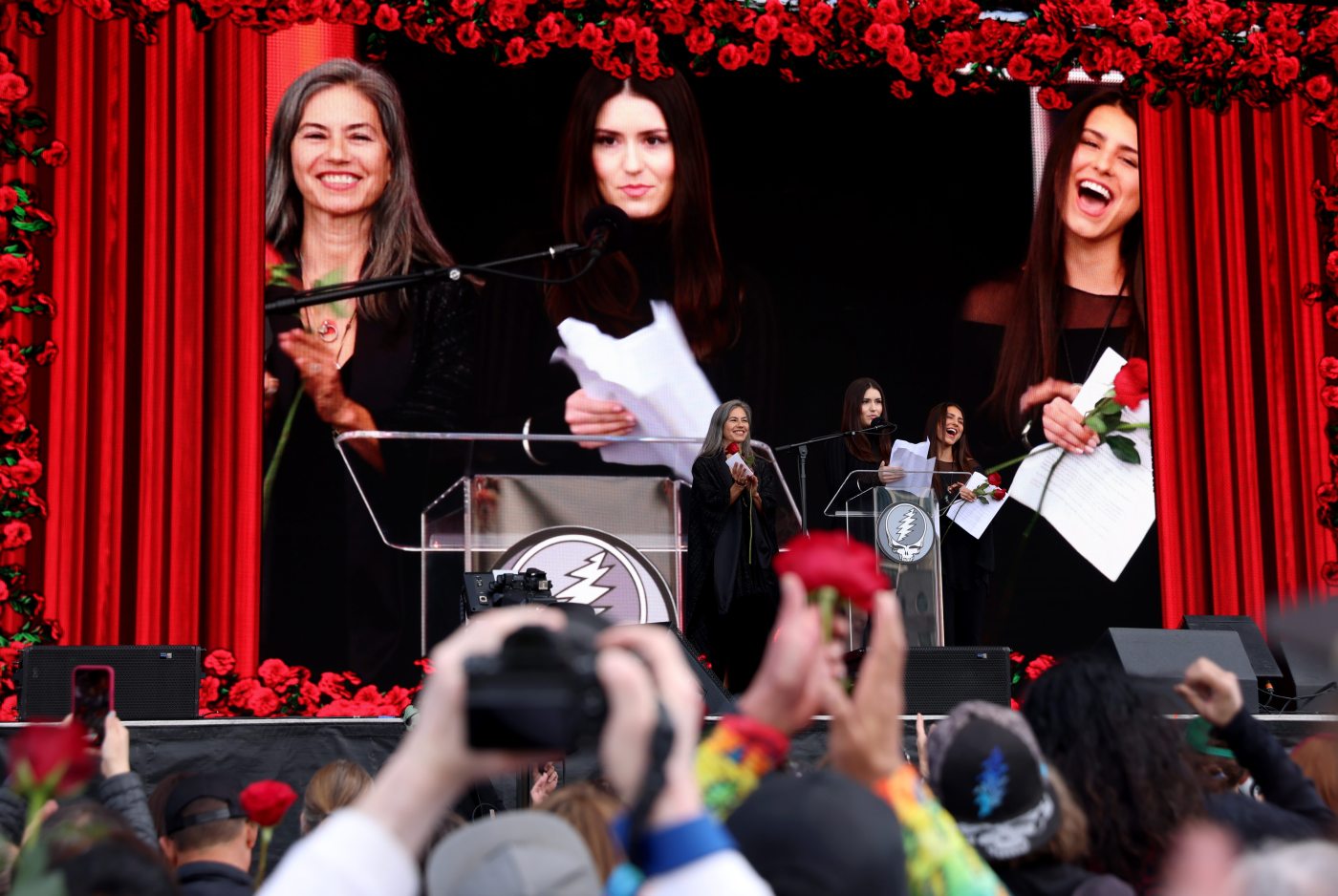
In a crowd filled with tie-dye and flowers, thousands gathered Saturday under the bright blue Bay Area sky, clapping, playing tambourines, and chanting “you know my love will not fade away” to honor the late Grateful Dead guitarist and vocalist Bob Weir.
The memorial event, dubbed “Homecoming,” brought together fans, friends, family members, and dignitaries to honor the artist and highlight his legacy as a musician who built community with his art and hoped to make the world a better place.
“It’s about love. You could see people from all walks of life—a cowboy, a hippy, and whatever—all getting along. There’s this sense of peace and tranquility, and we need more of that,” said Eric Hoffner of Los Gatos, 66, who has been following the band around the country since 1976. “It’s not the end of an era, it’s another step in the road.”
Bob Weir, a founding member of the Grateful Dead and one of the defining figures of psychedelic rock and the jam-band movement, died on January 10 of lung issues after battling cancer, according to a statement from his family. He was 78.
Weir co-founded the Grateful Dead in 1965 in Palo Alto. Over the years, the band built the most famously devoted fanbase in rock history, known as the Deadheads, mainly through constant touring and a commitment to changing up the setlist on a nightly basis so that no two Dead shows were the same.
On Saturday, Deadheads came from Southern California, Eugene, Oregon, and beyond to attend. Magnolia Grieco, 37, drove more than six hours from Santa Monica to honor Weir.
“If this music has been a part of your life, I can’t imagine how you couldn’t be here,” said Grieco. From her 84-year-old father to her 2-year-old nephew, she said Grateful Dead’s music had brought together her family and others in the community.
“I mean, Bob Weir united generations,” said Grieco, who has a Grateful Dead lightning bolt tattoo on her arm.
Many echoed that sense of unity, saying that Weir’s legacy, and that of the band, was to bring people together.
“It was the music, the ethos of kindness,” said Greg Hanson of San Rafael, who handed out roses to honor Weir’s passing. He said he had been a fan since 1968 and first saw the group playing in small clubs rather than stadiums.
“They gave their lives to making their fans’ lives better. This is a great way to send him off.”
At Saturday’s service, groups of friends and collaborators shared messages both in person and virtually—from Gyuto monks chanting in saffron robes, to videos from Willie Nelson, and speeches from Joan Baez and San Francisco Mayor Daniel Lurie.
Former Speaker of the House Nancy Pelosi called Weir “a force of nature” and “one of the great dreamers” who was “restless, curious, and kind.” She sniffled as she spoke of the artist who had such an impact on the Bay Area and worldwide.
“The music will never stop, the love will not fade, and the light you brought into this world will continue to guide us like a familiar melody we carry with us wherever we go,” said Pelosi.
John Mayer, who had played with Weir for years as part of Dead and Company, described Weir as an invaluable mentor who took a chance to allow him to “study under a master.”
“He gave me a musical community, he gave me this community,” said Mayer, holding back tears. “We’ve only begun to make sense of what’s gone missing. Thank you maestro, you’ve changed my life and I will love you forever.”
Bandmate Mickey Hart offered a speech full of laughter in remembrance of “the band clown” who was constantly breaking the rules and pushing boundaries. Hart said Weir enchanted him from the moment he first heard him play.
“He was singular. He was not a copy of anyone before,” said Hart.
Hart, like many on the stage and in the crowd, spoke of Weir’s vision of a musical legacy that could last 300 years, promising that the music and the community that had evolved around it would live on far beyond Weir’s death.
“He had that kind of vision. He knew that the songs would have a life of their own, not because of us, but because of you,” said Hart to the crowd.
Weir’s family—his wife, Natscha Münter, and daughters, Chloe and Monet Weir—ended the program by speaking of his role not only as a father and a musician but also as an activist who believed in the power of music to change and connect.
Eldest daughter Monet Weir highlighted her father’s role as an activist and an advocate for human rights, who, despite being a staunch Democrat, frequently referred to “our friends the Repubs” and hoped for unity.
“Even when people disagree, they should try to work together to build a better humanity,” she said. “Music can bring us together in these divided times—keep listening to the music.”
As Saturday’s memorial came to a close, the mix of family, friends, and dignitaries joined the thousands in attendance to sing “Ripple” in homage to the late musician.
While bubbles and smoke rose above the swaying crowd and many wiped away tears, the lyrics echoed out into the bright, warm afternoon:
“Would you hear my voice come through the music?
Would you hold it near, as it were your own?”
https://www.mercurynews.com/2026/01/17/bobby-weir-memorial-grateful-dead-san-francisco/